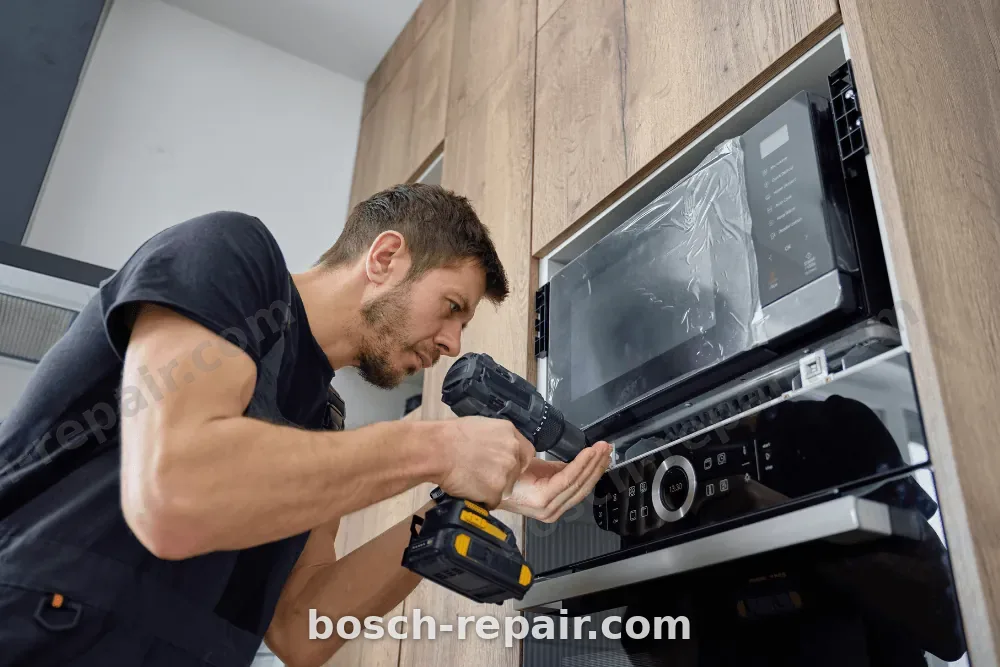
Bosch Oven Thermostat and Temperature Sensor Replacement in Dubai: Too Hot, Too Cold, Uneven, What Bosch Says, and Cost
When a Bosch oven burns the top of a cake and leaves the middle raw, owners search for "thermostat replacement". Bosch's own support pages never use that word. Bosch UAE says that "an oven with a faulty temperature regulator is always a case for the experts". Its separate page on an oven that no longer heats attributes the fault to "the heating system or heating element". Neither page names a sensor, a thermostat or any step you can take.
That leaves a gap between the word people search for, the words Bosch uses, and the parts a technician actually tests. This page closes it. It explains what "thermostat", "regulator" and "sensor" mean on Bosch's pages and on ours, sets out what Bosch UAE, the US, Singapore and Egypt say about an oven that runs wrong, gives the checks that belong to the owner before you blame a part, and says which parts a technician separates with a meter. It ends with what a repair costs in Dubai.
We repair Bosch appliances. We are an independent company and not an authorised Bosch agent. If your oven is inside Bosch's warranty, call Bosch first. For other oven faults, demo mode, the child lock and the full price table, see our Bosch oven repair page.
At a glance
- Bosch UAE's wording for a wrong temperature: "There must be something wrong with the oven temperature." A "faulty temperature regulator" is "always a case for the experts".
- Bosch UAE's wording for an oven that does not heat: a "technical fault" in the "heating system or heating element". No thermostat or sensor is named.
- Bosch US gives the only owner checks: the automatic convection setting can lower the set temperature by about 15 degrees, old and new ovens differ, and foil should not cover the whole shelf.
- Bosch Singapore blames the element: a working element "should appear bright red when heating; if it appears dark grey, it may need replacement". It advises against repairing it yourself.
- No Bosch page we read gives a calibration step, a thermostat test, or a sensor replacement procedure.
- The temperature codes on our oven page come from Coolblue, a retailer's advice page, and not from Bosch. We label them that way.
- A cheap oven thermometer on the middle rack shows whether the cavity runs hot or cold, according to our oven page.
- A sensor repair in Dubai: typically AED 170 to 360 before 5% VAT, with a 90-day warranty on our repairs.
Thermostat, regulator or sensor: what the words mean
Three words describe the part that decides how hot the oven gets. They are not interchangeable, and Bosch's pages use only one of them.
| Word | Where it appears | What it refers to |
|---|---|---|
| Temperature regulator | Bosch UAE and Egypt, "oven temperature" | The part that controls the temperature. Bosch does not describe it |
| Heating system or heating element | Bosch UAE "oven no longer heating up"; Bosch Singapore "oven is not heating up" | The element that makes the heat. Singapore describes its glow |
| Temperature sensor | Our oven page | A sensor in the cavity that the oven uses to decide when to heat |
| Thermostat | The search term | Not used on the Bosch pages we read |
What we can say
Our oven page says the oven decides when to heat from a sensor in the cavity, and that a failing sensor can make the oven heat too little, too much, or stop early. It also lists the heating elements, the relay and the control module, and a thermal fuse, as separate parts. That is our description, written for owners, and the Bosch pages do not go into it.
What we cannot say
We cannot tell you which of the words Bosch uses for your model. The Bosch pages we read do not say which models carry which part, and we do not guess from the series number. The model code and the technician settle it.
Why the words matter
If you ask a technician for a "thermostat" and your oven has a sensor, you may order the wrong thing. Describe the symptom and send the model code. We name the part after diagnosis, and the quote lists it.
What Bosch's pages say
We read the oven temperature and heating pages on four Bosch sites. They differ more than the titles suggest.
| Bosch site | What it says | Owner checks | Parts named | If it continues |
|---|---|---|---|---|
| UAE, "oven temperature" | Cakes come out "half-done or burnt" even at the recipe temperature. "There must be something wrong with the oven temperature" | None | A "faulty temperature regulator" is "always a case for the experts" | Bosch customer service can resolve it "whether the oven fails to reach the temperature or cannot maintain it". Numbers: +971 600 522 553 and BSH 048030400 |
| UAE, "oven no longer heating up" | Heating too much, heating unevenly, not heating enough, or the bottom heat not working. "A technical fault" | None | "The heating system or heating element" | Customer service. The page says support "costs less than you might think" |
| US, "oven temperature not right" | Convection auto settings, old versus new ovens, heat circulation | Check the automatic settings, follow the manual, leave about 2 inches behind the shelf, do not cover the whole shelf with foil | Elements, only if baking is uneven | Bosch Customer Service, a servicer finder and a chat option |
| Singapore, "oven is not heating up" | The oven turns on but does not heat | Check the element for burns or damage. A working element should glow bright red | The heating element | Book a Bosch engineer. "We advise against attempting repairs yourself" |
| Egypt, "oven temperature" | The same text as UAE | None | "A faulty temperature regulator" | Customer service. A call centre number and email |
What the pages agree on
All of them treat a wrong oven temperature as a job for customer service, with the US page the only one that gives checks first. The UAE and Egypt pages say the same words about the regulator. No page offers a calibration step.
Where they differ
The UAE and Egypt pages talk about the regulator and the temperature. The UAE heating page and the Singapore page talk about the element. The US page talks about settings and cookware. They describe different faults under similar headings, and each is right for its own symptom. A cake that burns on top is a temperature question. An oven that does not heat at all is an element question.
What none of them gives
- The name of a sensor, or how it works.
- How to test a thermostat, a regulator or a sensor.
- A way to tell a drifting temperature from a failed part.
- A price.
A note on phone numbers
The Egypt page prints a placeholder where a 24-hour number should be, so we do not rely on it. For the UAE, Bosch's pages give +971 600 522 553 and BSH 048030400. Our independent service centre page explains how to decide between Bosch support and an independent repairer.
Is it the oven or the cooking
Before you blame a part, rule out the causes that are not faults. Bosch US names three, and our oven page adds the rest. The order is the cheapest first.
- The automatic setting on a convection oven. Bosch US says to check the automatic settings, as they can lower the set temperature by about 15 degrees on convection ovens. If your recipe ran fine on an old oven and runs short on a new one, this is the first thing to read in the manual.
- A new oven. Bosch US says differences in timing or cooking performance between old and new ovens are "not unusual". Follow the recipe times, temperatures and rack positions in your manual.
- Foil. Bosch US says never to cover the entire shelf with foil, and to leave about 2 inches behind the shelf for heat to circulate.
- The tray. Our oven page says a dark tray absorbs more heat than a pale one, and a tray that fills the rack can block the airflow. Move the food one level and try a lighter tray.
- The program. Our oven page says top and bottom heat, grill, hot air and 4D Hotair behave differently. A recipe for top and bottom heat will burn on one side under a grill program.
- The fan. On a hot-air model, a fan that has stopped makes the temperature uneven. Our oven page covers it.
What this tells you
If one of these fixes the result, there is no part to replace. If the oven still runs wrong after all six, the cause is inside it, and Bosch's pages say to call.
One caution about the settings
Demo mode and the child lock stop an oven heating at all. They are on our oven page. They do not explain an oven that heats and then runs wrong.
A thermometer test you can do
Our oven page suggests a cheap oven thermometer left on the middle rack to show whether the cavity runs hot or cold. We give the method here, because it is the best evidence you can bring to a call. The steps are ours.
- Place the thermometer on the middle rack, away from the walls and the elements.
- Preheat to a common temperature such as 180 °C on top and bottom heat, and wait until the oven says it is ready.
- Leave it for about ten more minutes, then read the thermometer through the glass without opening the door more than you must.
- Note the gap between the setting and the reading.
- Repeat on another day, and note whether the gap is the same.
How to read it
Our oven page says a few degrees is within what home thermometers can show, and a large, repeatable gap is worth reporting. We do not give a threshold, because home thermometers vary and Bosch's pages give none. A gap that changes every time points to something other than a fixed offset.
Which setting to test
Test on the program you use most. Our oven page says the programs behave differently, so a reading on grill tells you nothing about top and bottom heat.
What to tell us
The setting, the thermometer reading, how long you waited, and the model code. That gives the technician a starting point and tells us whether to bring a sensor.
Sorting the symptom
Different complaints point at different parts. This table is ours, built from our oven page and Bosch's wording.
| What you see | What it can point to | Source |
|---|---|---|
| The oven does not heat, but the display, light and fan work | An element, the sensor or a relay | Our oven page |
| The oven does not heat and nothing works | Power or the control module | Our oven page |
| The bottom heat does not work | The bottom element, or a part feeding it | Bosch UAE lists the symptom |
| The top cooks and the middle stays raw | A setting, the tray or the program first. Then an element | Bosch US; our oven page |
| Food burns on one side | One element of a pair, the fan, or the rack position | Our oven page |
| The oven heats too much | The heating system. A sensor reading wrongly can do it | Bosch UAE; our oven page |
| The temperature drifts between cycles | The sensor, or the control module | Ours |
| A temperature code on the display | The sensor, per the sources below | Coolblue |
Why we do not name one part
Four different parts can produce "the oven does not heat enough". A technician separates them. Naming one from a description would be a guess, and Bosch's own pages do not make that guess either.
The question that narrows it
Does the light come on, does the fan run, and does the display respond? Our oven page says a working fan and light with no heat points at the elements, the sensor or the relay, and a dead everything points at power or the control module. That one answer saves the technician a lot of time.
Codes that mention temperature or the sensor
Bosch's UAE pages for ovens give no code list that we could find. The codes on our oven page come from other sources, and we label them.
| Code | What it is said to mean | Source | What to do |
|---|---|---|---|
| 000 | The oven is still too hot to start a program | Coolblue | Wait for it to cool |
| E115 | Temperature too high | Coolblue | Let the oven cool for 30 minutes or more. The door is often locked while it shows |
| E0511, E8401 | Temperature sensor | Coolblue | Switch off for about 20 minutes. If it returns, replacing the sensor is the next step |
What Coolblue is
Coolblue is a retailer, and its page is advice for owners of Bosch and Siemens ovens. It is not a Bosch page. We use it because it is the only source we found that lists these codes, and we say so each time. Our oven page treats the codes as leads and not as rules.
How to use them
A protection message on a hot oven is not a fault. A sensor code that returns after a break is a lead for a technician, who reads the oven's own diagnostics and tests the sensor. Do not buy a sensor from a code.
Other codes
Other sensor-related codes are quoted on repair sites. We do not repeat them, because we could not tie them to a Bosch page.
Sensor, element, relay or board
Our oven page lists the parts a "does not heat" fault can end at, in the order a technician tests them. This section turns that into a table, and the table is ours.
| Part | What it does | What a fault looks like | Who tells it apart |
|---|---|---|---|
| Temperature sensor | Tells the oven how hot the cavity is | The oven heats too little, too much or stops early. A sensor code | A technician with a meter |
| Heating element | Makes the heat | No heat from top or bottom. A visible blister, break or white burn mark | You can look with the oven cold and off. A technician tests it |
| Relay or control module | Switches the elements on and off | No heat while an element looks fine | A technician. A failing module can look like a failed element |
| Thermal fuse | Protects against overheating | The oven dies after overheating | A technician. The question is what caused the overheating |
| Fan | Moves heat in a hot-air model | Uneven heat, noise from the back | You can hear it. A technician tests it |
What you can check yourself
Only one thing in the table: a look at the elements with the oven off and cold. Bosch Singapore says a working element should glow bright red, and our oven page says a visible blister, break or white burn mark is a failed element. Neither page tells you to remove anything.
Why we do not suggest buying a part first
Our oven page says a module that no longer sends power can look exactly like a failed element, and a technician separates the two with a meter. A part bought first may be the wrong one.
A three-bake log
One odd result is not evidence. If you can, keep a short log over three bakes before you call. This method is ours, and it gives the technician more than "it burns".
| Bake | Program and temperature | Rack level | Tray and foil | Result (top, middle, bottom) | Thermometer reading |
|---|---|---|---|---|---|
| 1 | |||||
| 2 | |||||
| 3 |
What to hold constant
Use the same program, the same rack level and the same tray each time. Bosch US says rack positions and recipe temperatures come from the manual, so use the manual's figures for the first bake. Change one thing between bakes, and write down which.
What the log shows
A fault that follows the oven, with the same result under the same settings, points at the oven. A result that changes when you change the tray, the rack or the foil points at the cooking. If the thermometer reads far from the setting every time, tell us the gap and the program.
Why it matters
It saves the inspection if the cause is the tray. If it is not, it tells the technician whether the problem is a steady offset or a drift. Our oven page says a large, repeatable gap is worth reporting.
How a technician separates the causes
This is our method and not a Bosch procedure. We set it out so you can see what the inspection buys.
Before the visit
We ask for the model code, the symptom and the thermometer result. Whether the oven does not heat, heats too little or heats unevenly decides which parts we bring.
On site, outside in
The technician starts with the settings: demo mode, the child lock, the program and the convection auto setting. Then the oven is run against a thermometer, the elements are checked by eye with the oven off, and the fan is listened to. Only when those are clear does the work move to the sensor, the relay and the module, which need a meter and the oven pulled forward.
Why the order matters
A sensor replaced for a tray problem is money spent for nothing. A sensor replaced when the module was the cause is money spent twice. The inspection exists to prevent both, and the AED 99 comes off the repair if you go ahead.
What happens if it is a setting
If the cause is a setting or the cooking, we tell you, show you what we changed, and charge the AED 99 inspection only.
What happens when it is the sensor
We name the part on the quote, give the price including the AED 99 credit, and tell you whether it is on the van. If not, we order against the model code and you approve the price before anything is ordered.
A new oven that cooks differently
A common version of this complaint is "my new Bosch oven burns everything". Bosch US says differences in timing or cooking performance between old and new ovens are "not unusual", and tells you to follow the recipe times, temperatures and rack positions in your manual. That is the whole of Bosch's advice on it.
Our approach
This part is ours. Treat the first few bakes in a new oven as a calibration of you, not of the oven. Use the manual's rack levels and the program it recommends for the dish, bake on the lower end of your usual time, and check early. If the same dish comes out the same way each time, even if it differs from your old oven, the oven is behaving consistently, and you are adjusting a recipe and not repairing a part.
When to suspect a fault
When the result is inconsistent, when a thermometer shows a large and repeatable gap from the setting, or when a code appears. Those are the cases Bosch UAE sends to customer service, and the cases where our oven page says to tell us what the thermometer shows.
Convection models
Bosch US says the automatic settings on convection ovens can lower the set temperature by about 15 degrees. If your old oven was not convection, that alone can change results. Read the manual for how to turn the automatic setting off or on for your model.
After a self-clean cycle
A temperature complaint sometimes appears straight after a pyrolytic clean. Our oven cleaning guide records that Bosch UAE says the cycle reaches 480 °C, and Bosch UK says 485 °C. The door locks while it runs.
What our oven page says
Our oven page says Coolblue describes E115 as the temperature being too high, that the door is often locked while it shows, and that the behaviour is protection and not a breakdown. If E115 returns after the oven is cold, the page says the temperature sensor is the more likely suspect, and that is a technician job.
What to do
Let the oven cool for 30 minutes or more, as that source says. If the code returns on a cold oven, or if the oven runs wrong in normal use afterwards, tell us the model code and the code. Do not force a locked door. Our oven page says prising at it cracks the frame or the glass.
Bosch first, or us
If your oven is inside Bosch's warranty, contact Bosch first. Bosch UAE gives +971 600 522 553 for large appliances, described as available around the clock, and BSH 048030400 for general support. We do not know whether both are current, and we give them as printed on Bosch's pages. Our independent service centre page explains how a warranty call and an independent repair fit together.
What to have ready for either
The model code from the rating plate, the thermometer reading, the setting and the program, and a description of what the food does. Bosch Singapore's page notes that the E-Nr and the FD production number are needed for booking, so photograph both.
Keeping an oven accurate
Bosch's pages give a few habits that protect heat and airflow, and our oven page adds more. We list them with their source.
- Do not cover the whole shelf with foil. Bosch US says never to, and to leave about 2 inches behind the shelf.
- Follow the manual's times, temperatures and rack positions, especially on a new oven. Bosch US.
- Check the automatic convection setting if results change. Bosch US.
- Keep the door seal clean. Our oven page says a torn or hardened seal lets heat out and makes the oven work harder. See our door hinge and seal guide.
- Do not slam the door. Our oven page says hinge springs wear faster with force.
- Use a pale tray for baking if edges burn. Our oven page.
- Clean the oven as the manual says. Our oven cleaning guide sets out Bosch's own steps for the glass, the cavity and the self-clean cycle.
- Do not ignore early signs. Our oven page lists a noisy fan, a door that sits slightly open and a slow warm-up.
What we cannot give you
How often a sensor should be checked, and how long it lasts. Bosch's pages give neither.
Questions to ask before you approve a quote
- Which part failed, and how was it confirmed? A sensor, an element, a relay, a module or the fan.
- Did you rule out the settings and the cooking first? The answer should mention the convection setting and the tray.
- Is the part confirmed for my model code, and is it in stock?
- Is the AED 99 inspection credited?
- What is the warranty on the part and the labour? Ours is 90 days.
- What will the oven read afterwards? A good technician checks against a thermometer after the repair.
- What if I decline? You pay the inspection and VAT.
A quote that cannot answer
A quote that cannot name the failed part has not finished diagnosing. A temperature fault has several possible ends, and a sensor replaced on a guess may leave the real fault in place.
Safety and what to leave alone
- Switch the oven off and let it cool completely before you look inside. A hot cavity is a burn risk.
- Do not test or replace an element, a sensor or a thermostat yourself. Our oven page says the elements and their wiring run at mains voltage, and the connections sit behind panels that need tools and the oven pulled forward from its housing.
- Do not keep using an oven that trips the breaker, smells of burning or has a damaged door. Our oven page says so.
- Do not use a gas oven with a flame that will not stay stable. Our oven page lists this among its gas cautions.
- Do not buy a sensor or thermostat from a code. Bosch names no part for a temperature fault.
Matching the part to your model code
Sensors, elements and modules are matched to the oven. Our oven page says the number a technician needs is the model code printed on the rating plate. On a built-in oven the plate is usually on the edge of the door frame or on the side of the cavity, visible when you open the door fully. Bosch Singapore's page adds that the E-Nr and the FD production number are on the rating plate and are needed for booking a repair.
Why the code matters
Our oven page says codes in the HBG and HJG families are typical of Bosch built-in ovens, and that the full code tells us which element, fan, sensor and control module your oven was built with. That is what lets us check availability before the visit.
What to photograph
- The rating plate, with the model code and the FD number if shown.
- The display, with any code.
- The thermometer reading beside the oven's setting.
- The elements, with the oven off and cold, if you see a mark.
Stock
Our oven page says model-specific parts are ordered once the fault is confirmed. We do not claim a part is original Bosch because of a number. The part number appears on your invoice.
The visit and the cost
The AED 99 inspection includes the visit, the diagnosis and a written quote. If you approve the repair, the AED 99 comes off the repair price. If you decline, it is all you pay.
Typical costs, excluding 5% VAT
| Fault | Usual cause | Typical fix | Time on site | Price (AED) |
|---|---|---|---|---|
| Temperature sensor fault | Sensor | Replace the sensor | 45 to 90 min | 170 – 360 |
| Not heating | Element, sensor, relay | Replace the failed part | 45 to 120 min | 180 – 520 |
| Fan fault | Hot-air fan motor | Replace the fan or motor | 60 to 120 min | 220 – 480 |
What moves the quote
The part decides most of it. A sensor, an element and a module are different parts. Access matters next: a built-in oven in a tall housing has to be pulled forward. Stock decides whether one visit is enough.
A worked example
A technician confirms a failed temperature sensor on a built-in oven. The all-in price is AED 260, which includes the AED 99 inspection. VAT adds AED 13, so you pay AED 273. If you decline the quote, you pay AED 99 plus AED 4.95 VAT, a total of AED 103.95.
The warranty
Every repair carries a 90-day warranty on the parts fitted and the labour for the repaired fault. If the same fault returns inside 90 days, we come back at no charge.
Repair or replace
Our oven page gives the rule: if a repair costs more than about half of a comparable new oven, or the oven is past about fifteen years with two serious faults, replace it. That rule is ours and not a Bosch figure. New Bosch ovens listed by UAE retailers on the date our oven page was written ran from about AED 4,409 to AED 7,999, so a sensor repair is a small fraction of a new oven.
What tips the sum
A sensor on an otherwise sound oven is a repair. A temperature fault with a door that no longer seals, a rusted cavity and another failed part is a different sum. Count the faults and not only the quote in front of you.
What to tell us
- The model code from the rating plate, as a photo.
- What goes wrong: burns on top, raw in the middle, too slow, too hot, or a code.
- The thermometer reading against the setting, and the program you tested.
- Whether the light, the fan and the display work.
- Whether it is a convection model, and whether the automatic setting is on.
- What you changed: the tray, the rack, the foil, the recipe.
- When it started, and whether the oven is new, moved or recently cleaned.
- Any code, as a photo.
- Access: the housing, and your building's rules.
What the sources leave open
Bosch's pages leave several things open, and we would rather list them than fill them.
- What Bosch means by "temperature regulator" in a given model.
- How to test or replace a sensor or a regulator. No page we read gives steps.
- Whether the oven's temperature can be calibrated, and how. Not covered.
- Which codes mean a sensor fault. The only list we found is Coolblue's, which is not a Bosch page.
- How long a sensor lasts, or how often it is the cause. Not covered.
- A price. The UAE page says support "costs less than you might think" and gives no figure.
If another site gives a confident answer to any of these, ask where it comes from.
Frequently asked questions
Why is my Bosch oven not at the temperature I set?
Bosch UAE says there must be something wrong with the oven temperature and that a faulty temperature regulator is always a case for the experts. Bosch US lists settings, an old versus new oven and foil as causes to check first.
Is the Bosch oven thermostat the same as the temperature sensor?
Bosch's pages we read do not use the word thermostat. Bosch UAE says "temperature regulator", and our oven page says the oven decides when to heat from a sensor in the cavity. We cannot tell from Bosch's pages how the two relate on your model.
How do I check my oven's real temperature?
Our oven page suggests a cheap oven thermometer on the middle rack. Preheat, wait, read it through the glass and note the gap against the setting. A few degrees is within what home thermometers can show.
Can I calibrate a Bosch oven?
The Bosch pages we read give no calibration steps. Check your manual for your model, and do not guess.
Why does my convection oven run cooler?
Bosch US says the automatic settings on convection ovens can lower the set temperature by about 15 degrees. Check the setting before you suspect a part.
What does E0511 or E8401 mean?
Coolblue, a retailer's advice page, lists them as temperature sensor codes on Bosch and Siemens ovens and says to switch off for about 20 minutes. They are not from a Bosch page, and we treat them as leads.
Can I replace the temperature sensor myself?
We do not recommend it. Our oven page says the wiring runs at mains voltage behind panels that need tools, and Bosch Singapore advises against repairing it yourself.
How can I tell a failed element from a failed sensor?
Bosch Singapore says a working element should glow bright red, and our oven page says a visible blister, break or white burn mark is a failed element. A technician separates the rest with a meter.
How much does it cost in Dubai?
A sensor repair is typically AED 170 to 360 before 5% VAT, with the AED 99 inspection credited if you approve. The written quote gives the exact figure.
Is it worth repairing?
Usually, if the repair is under half the price of a comparable new oven. Our oven page gives the rule and examples.
Should I check the oven with a thermometer before I call?
Yes. Our oven page suggests a cheap oven thermometer on the middle rack. The gap between the setting and the reading, and whether it repeats, is useful to the technician.
Why do my baked goods burn on top and stay raw inside?
Bosch UAE says there must be something wrong with the oven temperature. Our oven page lists the tray, the rack level, the program and the fan as non-fault causes to check first.
My oven is under warranty. Should I still message you?
Contact Bosch first. We are an independent repair company and not an authorised Bosch agent, and a repair by us may not be covered by the manufacturer's warranty terms.
Book an oven temperature check
Send us the model code, a photo of your thermometer beside the oven's setting, and a line on what goes wrong: burns on top, raw in the middle, too slow or a code. We confirm a time window and the price range before we set off. Send us a WhatsApp message with the photos, or use the online booking form. We repair Bosch ovens across Dubai, with typical arrival times of 50 to 75 minutes after the technician sets off. Prices shown exclude 5% VAT.
Independent Bosch appliance repair specialists. Not affiliated with BSH.