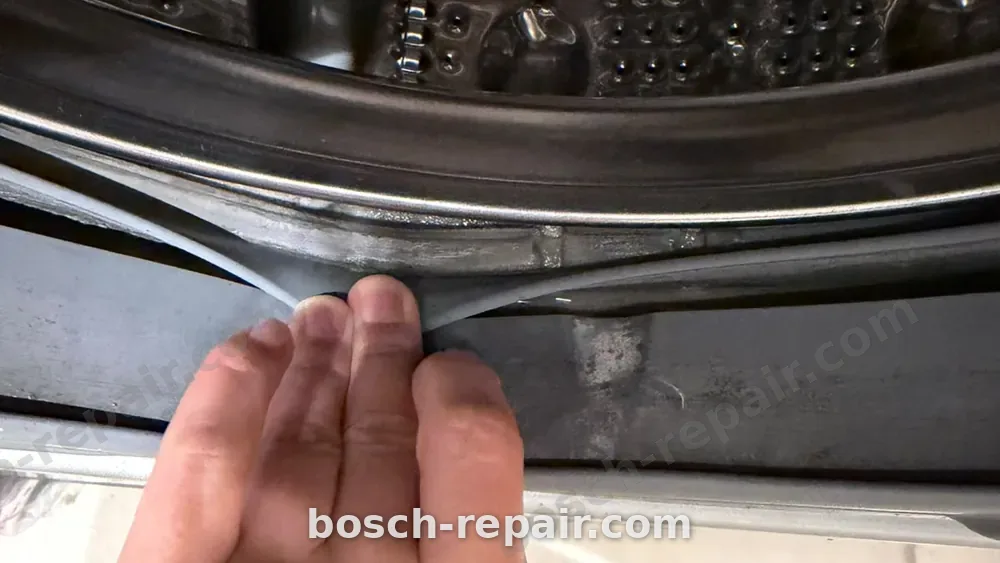
Bosch Washing Machine Door Seal Replacement in Dubai
The rubber ring around the door of a Bosch front-loader has several names. Owners call it the door seal, the rubber seal, the gasket, the boot or just "the rubber". Whatever you call it, it is the one soft part that holds the water in at the front of the machine, and it is the part most people blame when a puddle appears on the kitchen floor.
Sometimes the blame is fair. A torn or split seal leaks, and the only cure is a new one. But Bosch's own leak pages list several other causes alongside the seal, and a new seal fitted to a machine whose real problem is an overloaded drum or too much detergent will leak again within a week. Most of this page is about telling those cases apart, because that decision saves more money than any discount on the part.
We are an independent Bosch appliance repair company in Dubai, not the manufacturer, and we are not an authorised Bosch agent. If your machine is inside Bosch's warranty, call Bosch first. For the wider picture of washing machine faults and prices, see our Bosch washing machine repair page. This page covers one job only: deciding whether the door seal needs replacing, and what that replacement involves.
At a glance
- Typical cost: a seal-related leak falls in our AED 180 to 380 range, excluding 5% VAT. The AED 99 inspection is credited to the repair if you go ahead.
- Where the leak is: water at the front of the machine, around the door, is the case where the seal is a suspect. Water from the drawer, the back or the bottom points elsewhere.
- Before you book: check that the door closes with a click, that nothing is trapped, that the drum is not overfilled, that the machine stands level, and that the seal is clean. These are Bosch's own first checks.
- Mould and smell: usually a cleaning job, not a replacement. Bosch UAE recommends a 60 °C or hotter wash and a Bosch machine cleaner every three months.
- The part is model-specific. Send us the E-Nr and FD numbers from the rating plate and we confirm the right seal before the visit.
- What we do not claim: Bosch publishes no replacement procedure and no "replace when" rule that we could find. Where this page gives either, it says so.
Is it really the seal? Work through the front leak in order
A front leak has more causes than the seal. The order below follows the leak pages of Bosch UK and Bosch Singapore, which are regional pages, not UAE ones. We found no Bosch UAE page on leaks, so we use the UK and Singapore lists and note where they agree. Each step takes a minute or two and costs nothing.
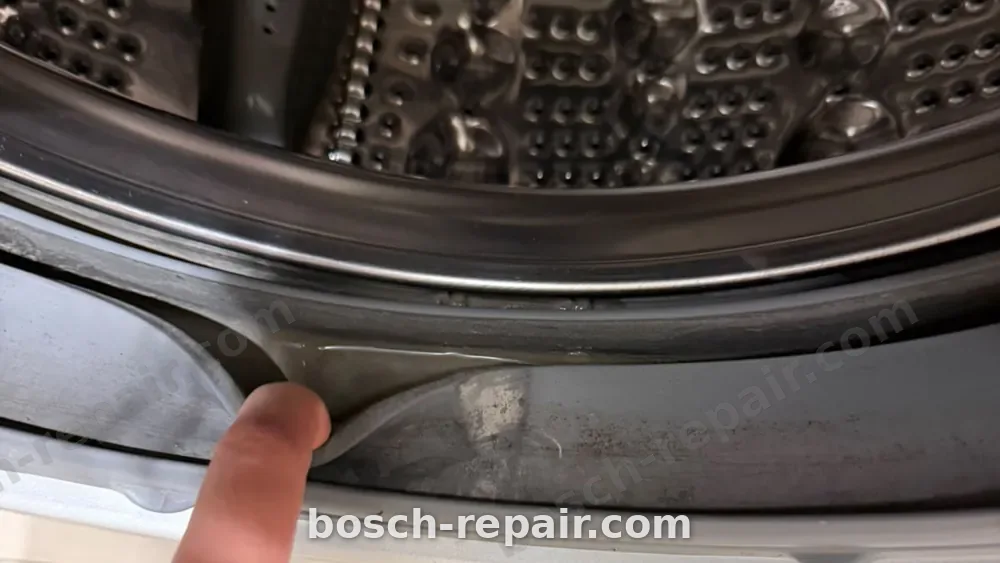
1. Is the door fully closed?
Bosch UK says the door should be fully closed with a click. Our reading: a door that looks shut but has not latched cannot press the seal evenly, so a leak that starts as soon as the drum takes on water is worth checking against the latch first.
Open the door and close it firmly with the flat of your hand. You should feel and hear the catch. If the door will not latch, or feels loose, or needs a slam to close, that is a hinge or lock problem and a new seal will not touch it. Bosch UK's page on a door that will not open or close lists the child lock, an overloaded drum and a trapped item among the causes, and says a faulty lock needs a trained engineer. Our reset guide covers the child lock and the door release in detail.
2. Is anything trapped in the seal?
Bosch UK lists trapped items first when the door will not close, and the same logic applies to a leak. A sock, a tissue or a strap caught between the door glass and the rubber stops the door closing cleanly against the seal, and our reading is that water can then escape at that point.
Look all the way around the ring, not just at the bottom. Run a finger around the lip where the glass meets the rubber and feel for anything caught. If you find a trapped item, remove it, dry the area and run a short rinse before drawing any conclusion.
3. Is the drum overfilled?
Bosch UK says not to overfill. The manuals in our other guides give loading limits by model, in kilograms of dry laundry, not in how much fits in the drum.
Our suggestion, labelled as ours: if the leak happens only with big loads, such as duvets, bath towels or a full week of school uniforms, and never with small ones, the seal is probably fine and the load is the cause. Test with half a load of the same fabric before you spend money.
4. Is the machine level?
Bosch UK includes levelling in its checklist. Put a spirit level on top of the machine, front to back and side to side. Press down on each corner. If it rocks, the feet need adjusting. Bosch's manuals describe the foot adjustment for each model, and we do not repeat them here because they differ.
5. Is there excess detergent foam?
Bosch UK names excess detergent foam as a cause of front leaks. Bosch US makes a related point about the drawer: too much detergent, or old detergent, causes leaks there.
Check the dose against the detergent's own instructions for your load size and water hardness. If you see foam pressed against the glass during a wash, or a thick film of suds on the seal afterwards, cut the dose and run a rinse programme. Bosch UAE's smell pages say the same about using the right amount of detergent, though it frames the point as a cause of odour.
6. Is the seal contact area clean?
Bosch UK and Bosch US both say to keep fluff and detergent residue off the seal and the area it touches. Bosch US describes the front door gasket as "meant to create a tight seal", and a layer of lint or hardened detergent on the contact surface stops that seal from forming.
Wipe the seal and the door glass edge with a damp cloth. Look at the lip of the rubber and the ring of the door where they meet. If a wipe and a rinse cycle cure the leak, you have saved the cost of a visit.
7. Only then, is the seal damaged?
Bosch Singapore is the one source we read that tells you to check the seal for damage, "since damage can cause leaks". It also advises against DIY repair and asks you to note the E-Nr and FD numbers from the rating plate before you call.
If you have worked through steps 1 to 6 and the front leak continues, the seal is the leading suspect. Look for the damage signs in the next section. If none of them fit, book an inspection so the leak can be traced to its source.
What the leak is not
Water from the drawer, from the back, or from beneath the middle of the machine is not a door seal problem. The drawer causes are above. Our washing machine repair page covers hose, valve and pump-housing leaks. If the machine also shows a fault code, check it before you assume the rubber is the cause. E18, for example, is a draining fault, and a machine that cannot drain can overfill the drum and push water out at the door. See our E18 guide.
Cleaning or replacing: what mould and smell mean for the seal
This is the question most owners get wrong, in both directions. Some replace a seal that only needed cleaning. Others scrub for months at a seal that has already failed.
What Bosch says to do
Bosch UK and Bosch Singapore give the same cleaning instruction: wipe the seal, inside and out, with a damp clean cloth, then run a maintenance wash. Both say that mould tends to develop in the folds of the seal if it is not cleaned regularly, and that it tends to form while the machine sits unused. Neither gives a cleaning interval in days or weeks.
Bosch UAE's smell pages give three instructions. Wash at 60 °C or higher. Use the right amount of detergent. And use Bosch washing machine cleaner, part number 00311927, 200 g, one application every three months. A four-pack carries the number 00311930, and the page says to order it through an Authorized Service Center. The contact number on those pages is BSH 048030400. These pages say nothing about the seal itself, the drawer or the filter.
What Bosch does not say
We found no Bosch page, from any country, that tells you when a seal is too far gone to clean. There is no rule such as "replace after X years" or "replace when the discolouration reaches Y". Anyone who gives you a fixed interval is giving you their own estimate, and we do not have a source for one either.
What follows is our reading, not Bosch's. We separate the signs into three groups.
Signs that point to cleaning
- A surface film of black or grey spots that wipes off with a cloth and a little washing-up liquid.
- A musty smell with an otherwise intact seal. Our washing machine repair page describes the biofilm that causes it, and the drum, drawer and filter are often part of the problem as well as the rubber.
- Residue and lint packed into the lower fold, which comes out with a finger and a cloth.
For these, Bosch's own route is the one to follow: wipe, run a hot service wash with the Bosch cleaner or a similar product, then leave the door and the drawer ajar after use so the drum dries.
Signs that point to replacing
- A tear, split or hole in the rubber, however small. A cut does not close when the door shuts, and water finds it every cycle.
- A seal that has separated from its clamp or fold, so you can see the edge standing proud of the door ring.
- Mould that has gone through the rubber, leaving a spot that feels soft, sticky or eaten away, or that comes back within days of a thorough clean. Our services page puts it this way: mould that "has eaten through the rubber".
- A seal that has hardened or cracked, so it no longer springs back when you press it.
- A leak that continues after you have cleaned the seal and worked through the checks above.
Signs that are ambiguous
Staining alone is hard to judge. A stained seal that is intact and does not leak or smell can stay in place. A stained seal that also leaks needs a closer look, and that is what the inspection is for.
What we will not do
We will not replace a seal just because it looks old. If the seal is intact, does not leak and the smell is the only issue, we tell you to clean it and run the service wash. If the inspection shows the seal is sound and the leak comes from the load, the level or the detergent, we say so, and the inspection fee is what you pay for that answer.
Preventing it from coming back
These steps come from Bosch's cleaning and smell pages, with our own suggestions marked.
- Wipe the seal after washing, especially the lower fold where water pools. Bosch UK and Singapore both name the seal as a place that needs regular cleaning.
- Run a 60 °C or hotter wash on a regular basis, as Bosch UAE suggests. Bosch UAE gives no reason beyond the smell.
- Use the correct amount of detergent, as all the Bosch pages we read advise.
- Use the Bosch machine cleaner every three months, as Bosch UAE says, or follow the label of whatever cleaner you buy.
- Our suggestion: leave the door ajar between washes. Bosch's pages say mould tends to form when the machine sits idle, and a closed door traps the moisture.
Reading your model code and why the part is model-specific
A door seal is not a universal part. A seal that fits one Bosch front-loader can be the wrong size, shape or fixing for the one next to it in the shop. The evidence we have is from parts sellers, not from Bosch, so we treat it as a strong pointer and not as a specification.
What the parts sellers show
We read two retailer pages on 2 November 2026. Neither is a UAE seller.
- Screwfix, listing 00686004, describes a seal for "replacing a worn, split or damaged seal". It calls it a complete door seal replacement that includes the tub and front panel rings, and says it is compatible with selected models only. We do not quote its price, because it is a UK retail price in pounds and is not a Dubai figure.
- Oz Appliance Spares, listing 00772662, says its seal fits only three model codes: WGG24401AU/01, WGG24402AU/01 and WGG244A0AU/09. The box holds one gasket. The page calls it "genuine-fit", but its meta description says "genuine or compatible part", so the wording is not clear about which it is. If you buy from any seller, ask them to confirm in writing whether the part is made or approved by Bosch.
Our search also returned other listings with other part numbers for other models, among them Australian door boot seals for the WAT series and for a Serie 8 i-DOS model. We did not open those pages and we do not list their numbers. The point is the same in every case: the part number changes with the model.
Two practical lessons follow.
- Never order a seal from a photo or from the model name alone. "Serie 6" or "8 kg" does not identify a part. The full E-Nr does.
- Ask what is in the kit. The Screwfix listing includes rings. A seal sold without them may need your old rings reused, and a seal sold with them changes how much work the job is.
Where to find the E-Nr and FD numbers
Bosch Singapore asks you to note both numbers from the rating plate before contacting service. Bosch's manuals show where the plate sits on your model, so check the location in your booklet. Our model numbers guide explains how to read the code, what the letters at the front mean and why the market suffix at the end, such as GB, GC or AU, can matter.
The E-Nr is the model number, for example WAN28282GC. A technician uses it to look up the parts list. The FD number is a second identifier. Bosch's pages do not define it, and our reading is that it identifies your individual unit, which is why parts sellers ask for it too. Photograph the whole plate and send it. That one picture saves most of the back-and-forth.
Why the market suffix matters
Our model numbers guide covers the suffixes in detail. The short version: the same series name can sit on machines sold in different countries with different parts lists. One of the sellers above lists Australian codes with AU suffixes. If your machine was imported or moved from another country, tell us. We confirm the part against the code on your plate and not against a series name.
Seal, boot or gasket: do they mean the same part?
For this page they do. Listings say "door seal", "door gasket" or "door boot seal", and owners say "the rubber". In every case we mean the ring around the door opening that keeps water in. If you are not sure which part is leaking, a photo tells us.
What a replacement visit involves
Bosch publishes no replacement procedure for the door seal that we could find. The steps below describe our own process in general terms, informed by the fitting notes one parts seller publishes. They are not a Bosch method and they are not an instruction for you to follow. Seller notes mention a clamp, and kits that include rings, so the work needs the right tools and care.
Before the visit
We ask for the E-Nr and FD from your plate, a photo of the seal and a short description of when the leak happens. From these we work out the likely part and tell you if we expect to need to order it. If the part has to be ordered, the visit may split into two: one to confirm the diagnosis and one to fit.
We do not promise stock of every seal. The common ones for popular models are the ones we aim to carry, but the part list for your machine decides it. Where we do not hold the part, we tell you before we arrive and agree the plan.
Confirming the cause
The technician starts with the same checks you did: the latch, trapped items, load, level, detergent and contact area. If the cause is not the seal, we explain what it is and quote for that.
Fitting a new seal
The seller notes we read describe the general order of work. Oz Appliance Spares' page for its listing 00772662 says to disconnect the power first, to note the orientation of the old seal before removing it, to soak the new seal in warm water for about ten minutes to make it easier to fit, and to use long-nose pliers or a spring-clamp tool for the clamp, starting at the top. We cite this as a seller's note for a specific Australian model. It is not Bosch's instruction, and the details differ between machines.
In our own work the same ideas apply. Power is off and the plug is out. The old seal's position is photographed so the new one goes back the same way. The seal and its contact surfaces are cleaned before the new one goes on, which is our own practice. Where a clamp or ring holds the seal, it has to seat evenly all the way round.
Testing
After fitting we run the machine through a fill and a short wash and watch the door area. A leak that appears only at the spin stage is easy to miss in a short fill, so the test includes a spin. We check that the door still latches, that the seal sits clear of the glass edge and that nothing is pinched.
Time and mess
Time on site depends on the model and on whether the part is in the van. We do not give a fixed number of minutes, because we do not have a source that holds for every Bosch front-loader. We tell you what to expect when we confirm the part. Expect a little water when the old seal comes off, so we put down a towel.
What you need to do
Empty the drum. Clear the space in front of the machine. If it is built into a cabinet, tell us whether the kick-plate or door panel is already removable and whether your building needs notice for a technician's visit. A short video of the leak, sent on WhatsApp, helps us decide what to bring.
What we will not do
We will not remove panels or work on mains electrics on your behalf unless a technician is on site. And we ask you not to do either of these yourself. Washing machines carry mains voltage and water together, which is why we do not offer a DIY procedure on this page.
Cost: what a door seal replacement costs in Dubai
Our washing machine repair page gives a typical range of AED 180 to 380 for a leak caused by a worn door seal, a loose or split hose, or the pump housing. This page is about the seal, so here is how that range breaks down in practice. All prices exclude 5% VAT.
| Item | Typical range (AED) |
|---|---|
| Inspection (credited to the repair if you go ahead) | 99 |
| Door seal replacement, part and labour | 180 – 380 |
| Cleaning advice only, no new part | covered by the inspection |
| Seal plus a related fault, such as a faulty latch | quoted after diagnosis |
These ranges are our own pricing and not a market survey. We found no UAE retailer or service price for a Bosch door seal to compare them against, so we do not claim they match what others charge.
A worked example
A customer's front-loader leaks at the door during every wash. The seal has a clean tear at the bottom fold. The part is in stock and the fit takes one visit.
- All-in price: AED 280, including the AED 99 inspection.
- VAT at 5%: AED 14.
- Total: AED 294.
If the same customer declines the repair after the inspection, they pay the AED 99 fee plus VAT of AED 4.95, which is AED 103.95.
What pushes the price up
- A seal that comes with rings. The Screwfix listing shows that some kits include tub and front panel rings, so our reading is that the part and the job can be larger on those models.
- A part we need to order. The price depends on the model, and we quote it before we order.
- A second fault. A leak that has damaged the control module, or a lock that no longer latches, is quoted separately. Water that reached the control module turns a cheap repair into an expensive one, which is why we say to stop using a leaking machine.
What brings it down
- A seal that only needed cleaning, where the inspection is the whole cost.
- A cause you found yourself, such as a trapped item or an uneven floor.
Repair or replace the machine?
Our guideline, which is our reading and not a Bosch rule, is that a seal replacement on a machine in otherwise good condition is almost always worth doing. The decision changes when the seal is one of several problems, such as a failing motor, a bearing noise or a control module fault, or when the machine is old and the combined bill approaches the price of a new one. Our Serie 4 guide gives dated Dubai retailer prices, and our Serie 2 guide says where it could find none, so you can compare. For a machine under warranty, Bosch is the first call and not us.
After the replacement: keeping the new seal healthy
A new seal fails early for the same reasons an old one does. The cleaning habits above are the same, and a new seal gives you a clean start.
- Wipe the seal and the glass after the last wash of the day. Bosch UK and Singapore both say to wipe it with a damp, clean cloth.
- Leave the door ajar when the machine is not in use. This is our suggestion, based on Bosch's note that mould forms while the machine is idle.
- Run a 60 °C or hotter wash regularly and use the right amount of detergent, as Bosch UAE says.
- Use Bosch machine cleaner 00311927 every three months if you want to follow Bosch's own schedule. The UAE page says to order it through an Authorized Service Center.
- Look at the seal when you clean the filter. This is our suggestion. Our Serie 2 guide covers the filter.
- Do not overload the drum. Bosch UK lists it as a cause of leaks, and the load presses on the new rubber just as it did on the old.
What to expect in the first weeks
A new seal should not leak at all. If water appears at the door within the first few cycles, tell us straight away. The leak may mean the seal is not seated evenly, or that the cause lay elsewhere. Our workmanship warranty applies to the repair.
What to tell us when you book
You will get a faster, cheaper visit if you send the following. Together it takes a few minutes.
- The E-Nr and FD numbers from the rating plate, as a photo.
- Where the water is: front, drawer, back or bottom, and whether it appears at the fill, the wash or the spin.
- A photo of the seal, taken with the door open and a torch. Show the lower fold.
- What you have tried: the checks above, a cleaning wash, a reset.
- Any display message. A fault code changes the diagnosis. If the display shows an error, see our guides to E17 and E18, and our reset guide.
- Age and history: how old the machine is, and whether it has been repaired or moved.
- Access: your building, apartment number and parking, and any notice period your building requires. For an integrated machine, say whether the panel hides the controls.
If the machine is still in its warranty, tell us, and we advise you to contact Bosch before we touch it. We do not want to cost you your cover.
Frequently asked questions
How do I know if my Bosch washing machine door seal needs replacing?
Look for a tear, a split, a hole, a seal that has separated from its fold, or mould that has gone through the rubber. Work through Bosch's own first checks before you decide: door closed with a click, nothing trapped, load not too big, machine level, no excess detergent, and seal and contact area clean. If the front leak continues after all that, the seal is the likely cause.
How much does a Bosch washing machine door seal replacement cost in Dubai?
Our range for a seal-related leak is AED 180 to 380, excluding 5% VAT. The AED 99 inspection is credited to the repair if you go ahead. These are our own prices, and the part and the model decide where within the range you fall.
Can I replace the door seal on my Bosch washing machine myself?
Bosch Singapore advises against DIY repair and asks you to note the E-Nr and FD numbers and call service. We found no Bosch procedure for the job. A parts seller's notes describe disconnecting power, soaking the seal and using clamp tools, but they apply to specific models. We do not recommend it for an owner without experience.
Is the door seal the same on every Bosch washing machine?
No. The sellers we read show seals listed against particular model codes, and one lists only three. Some kits include tub and front panel rings. Send the full E-Nr, not just the series name or capacity.
Where do I find the E-Nr and FD numbers?
On the rating plate. Check your manual for its location on your model. Photograph the whole plate. Our model numbers guide explains how to read the code.
Will cleaning the seal fix the smell?
Often, yes. Bosch UK and Singapore say to wipe the seal and run a maintenance wash. Bosch UAE suggests a wash at 60 °C or higher, the right amount of detergent, and Bosch machine cleaner 00311927 every three months. If the smell continues, the drum, drawer or filter may also need cleaning.
How long does a door seal last?
We found no Bosch figure for the life of a door seal, and we do not give one.
My machine is under warranty. Should I still message you?
Contact Bosch first. Bosch UAE lists BSH 048030400 on its pages. We are an independent repair company, not an authorised Bosch agent, and a repair by us may not be covered by the manufacturer's warranty terms. Check your warranty documents.
Can a new seal still leak?
Yes, if the cause was not the seal. A leak from overloading, a tilt, excess detergent or a fault at the latch carries on after a new seal. That is why we run the checks before we replace anything.
Book a door seal inspection or replacement
Send us the model code from your rating plate, a photo of the seal and a short note on where the water appears. We confirm the likely part, a time window and the price range before we set off. Send us a WhatsApp message with the photos, or use the online booking form. We repair Bosch washing machines across Dubai, with typical arrival times of 50 to 75 minutes after the technician sets off. Prices shown exclude 5% VAT.
Independent Bosch appliance repair specialists. Not affiliated with BSH.